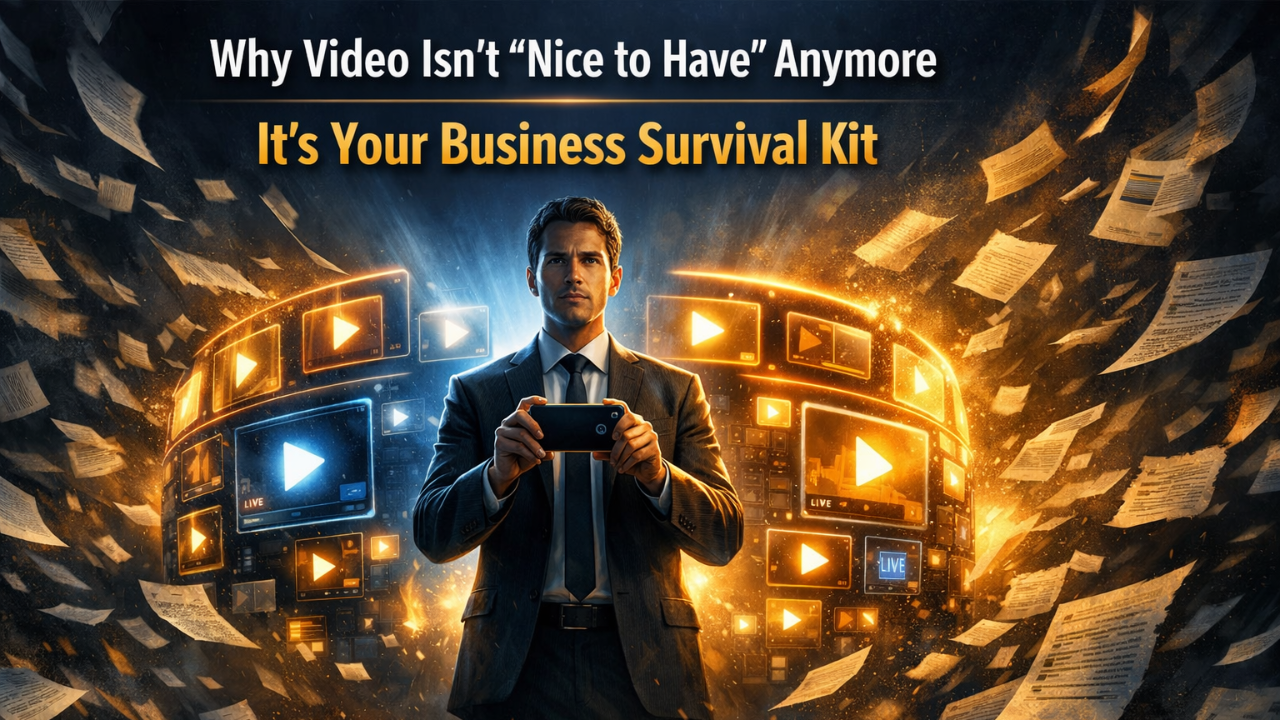
Why Video Isn't "Nice to Have" Anymore—It's Your Business Survival Kit
I was speaking at a conference in Florida last month, and a business owner asked: "Frank, video seems like such a big investment. We're doing fine with just written content. Why should we bother?"
I asked him: "How many of your competitors are using video?" He paused. "Most of them, actually." Exactly.
Here's what I've learned training businesses across 70+ countries:
Video isn't the future anymore. It's the present. And if you're still treating it like an optional extra, you're handing your competitors a megaphone while you're whispering into a tin can.
The numbers tell the story: 91% of businesses now use video as a marketing tool, and 85% of people have been convinced to buy a product or service by watching a video.
That's not theory. That's your revenue walking out the door if you're not in the game.
The £10,000 Mistake Nobody Talks About

Here's where I need to save you from an expensive blunder I see constantly.
You spend money creating a brilliant video. You upload it to YouTube. You embed it on your website. Job done, right?
Wrong. Catastrophically wrong.
Someone watches your video. It finishes. And then YouTube—being helpful—immediately shows them "related videos."
Which videos? Your competitors. Videos about similar topics. Literally anything except what you want them to see.
I watched a financial services company spend £10,000 on an explainer video, embed it via YouTube on their pricing page, and wonder why people weren't converting.
We discovered 40% of viewers were clicking on competitor videos YouTube suggested at the end. They were literally paying to send traffic to their competition.
Frank's Quick Tip: If you're embedding videos on your website, use Vimeo (paid plans start at £20/month) or another dedicated hosting service that gives you control over what happens at the end. Yes, it costs money. But it's a fraction of what you'll lose inadvertently promoting your competitors on your own website.
5 Ways Every Business Should Be Using Video Right Now
- Product demonstrations. Stop describing what your product does. Show it. 82% of people are more likely to buy after watching an explainer video.
A B2B software company I worked with created a 90-second screen recording showing exactly how a customer solved a real problem. Their demo request rate jumped 67% in two months. Shot on an iPhone, edited in an afternoon.
- Personalized sales videos. Instead of another text email, record a 60-second personalized video addressing your prospect by name. Tools like Loom make this easy. Open rates are consistently 3-5x higher. Why? Because authentic personal video stands out like a lighthouse in a sea of automation.
- LinkedIn thought leadership. Video posts on LinkedIn reach 5-10x more people than text posts with the same message. Film yourself sharing one practical insight. Natural light, iPhone, done. Keep it under 2 minutes. The content that performs best looks like it was made by a professional, not for one.
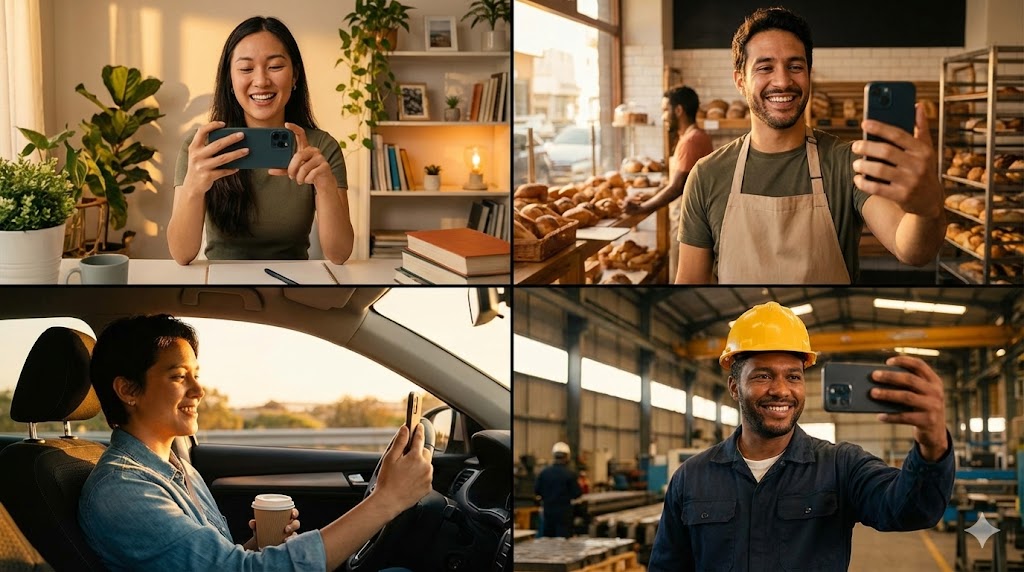
- Customer testimonials. Written testimonials are fine. Video testimonials are gold. You don't need professional videographers. Some of the most effective testimonials I've seen were customers recording themselves on smartphones. The authenticity matters more than production quality. I have over 65, take a look https://www.youtube.com/playlist?list=PLBFF5A8C8590F57B2
- Internal communication. How many company-wide emails get ignored? Most of them. Now imagine your CEO records a 90-second video update instead. Engagement will be dramatically higher. I've seen this transform company culture in organizations from Dubai to Denver.
The Tools You Actually Need (Spoiler: Less Than You Think)
You probably already own the best camera you need. It's in your pocket. Modern iPhones shoot in 4K quality that's genuinely professional—78% of LinkedIn videos are shot with a smartphone. The barrier to entry isn't equipment. It's pressing record.
For editing: iMovie (free on iPhone) handles simple edits perfectly. CapCut is free and powerful for social media content.
For desktop, DaVinci Resolve is shockingly powerful and completely free. My personal favourite I use all the time is Camtasia.
But honestly? For 80% of business video needs, your iPhone and iMovie will get the job done.

The AI Video Revolution
AI video generation has gone from "interesting experiment" to "holy hell, this actually works" in about 12 months.
Sora 2 can now create professional-quality videos up to 25 seconds long from just a text description. Complete with sound effects, music, and realistic physics.
I tested it: "A professional presenter in a modern office explaining business strategy, warm afternoon lighting." Thirty seconds later, I had a video that looked like it came from a £5,000 production.
Perfect? No. Does it replace human creativity? Absolutely not.
But for B-roll footage, concept videos, or situations where filming isn't practical?
Genuinely transformative. Disney just invested £1 billion in this technology. That's not a small bet.
The Quality Question Everyone Gets Wrong
People obsess over 4K resolution, professional lighting, and expensive microphones. Here's what actually matters: audio quality and authenticity.
You can get away with iPhone video quality. You absolutely cannot get away with rubbish audio. Invest in a simple lapel microphone (£30-50) before anything else.
And authenticity? That's free. The most engaging business videos are people being genuinely themselves—imperfect, human, real.
Overly polished corporate videos that cost £20,000 often perform worse than authentic content shot on a phone.
The Bottom Line

Video is no longer competing with other content types. It's dominating them.
Your customers prefer it, algorithms favour it, and your competitors are already doing it.
The good news? The barrier to entry has never been lower.
You have a professional camera in your pocket. Free editing software exists. AI tools can fill in gaps. And authentic content outperforms expensive production anyway.
The businesses thriving over the next decade won't be the ones with the biggest video budgets.
They'll be the ones who understood that video is simply how humans prefer to consume information now—and they got comfortable pressing record.
So the question isn't "Should we use video?" anymore. The question is "How quickly can we start?"
Ready to build a video strategy that actually drives results without requiring a film crew? I work with businesses globally to develop practical, sustainable approaches to video content that fit how you actually work. Let's talk about what's possible when you stop overthinking it and start recording.
Stay connected with news and updates!
Join our mailing list to receive the latest news and updates from our team.
Don't worry, your information will not be shared.
